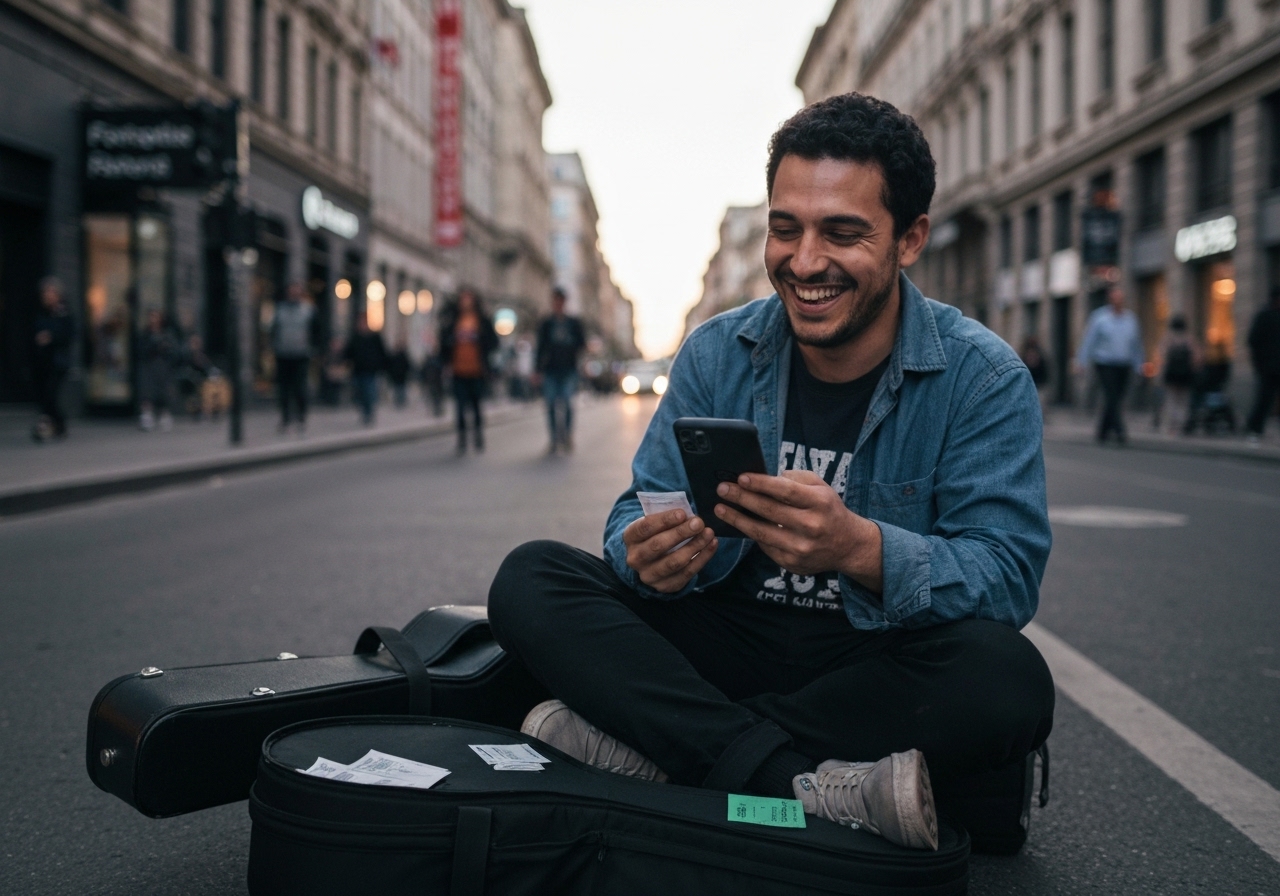
3 Secrets to Maximize Artist Tips with Digital Tools
You’ve just finished the set of your life.
The energy in the room is electric. People are clapping, cheering, and wiping tears from their eyes. You feel that buzz, the one that reminds you why you started performing in the first place.
You step off the stage or pack up your guitar case on the sidewalk.
Then comes the silence.
A few people wander over to say "great job," but the guitar case remains light. It’s not because they didn't ove it.
It’s because nobody carries cash anymore. We are living in a tap-and-go world, yet so many performers are still relying on a cash-only economy. This is where you need to shift gears.
If you want to survive and thrive in the modern creator economy, you have to maximize artist tips with digital tools.
It isn't just about having a PayPal account; it is about removing every bit of friction between your audience's appreciation and your bank account.
Let's be real for a second.
The starving artist myth is outdated. The tools exist right now to turn casual listeners into high-value supporters.
But most artists are using them wrong.
The Psychology of the Digital "Nudge"
But before we jump into the specific secrets for maximizing your tips with digital tools, we have to get inside people's heads a little. What makes someone decide to tip?
Tipping is pure emotional impulse.
It’s that exact moment a fan feels a real connection and wants to give some of that good energy back to you—this time, with their wallet.
And that impulse?
It vanishes in about ten seconds. If someone has to download an app, hunt for a username, or fumble around for a link, that urge to give just disappears.
This is why artists need a digital tip jar that is instant.
I was reading a study recently about friction in checkout processes.
While it was about e-commerce, the same logic applies to street performance or art exhibitions.
Every additional click cost you 50% of your potential revenue.
That is a staggering number.
Think about visual artists.
If you create amazing canvas work or oil paintings, you often display them in galleries or cafes. I found a great example of this with local Swiss creators who showcase their paintings online.
They understand that the visual connection is the first step, but the transaction mechanism is the second.
If a viewer loves a painting but can't buy it, they might want to support the artist with a small tip.
If there is no QR code next to the canvas, that opportunity is lost forever.
The Barrier of "Awkwardness"
There is also the awkward factor.
Walking up to a stage to drop money in a bucket takes a certain level of confidence. Many fans are shy.
They want to support you, but they don't want to be the center of attention. Digital tipping solves this beautifully.
They can support you from the back of the room, anonymously and generously.
This is the foundation. Now, let’s look at the three secrets to actually making this work.
Secret #1: Contextual Placement is Everything
Having a QR code is not a strategy.
It is like having a business card that you keep in your drawer. The first secret to maximize artist tips with digital tools is contextual placement. You need to put the trigger where the attention already is.
Most musicians print a small QR code and tape it to their mic stand. That is a mistake.
Why?
Because from ten feet away, in dim lighting, that QR code is unreadable.
You are asking your audience to zoom in with their cameras like snipers just to give you five bucks.
The "Billboard" Technique
You need to go big. If you are a street performer, your QR code should be the biggest thing on your sign.
It should be visible from twenty feet away.
If you are playing a venue, ask the venue manager if you can project your code on the wall behind you between sets.
If you are a visual artist, every single placard next to your art should have a mini-code.
Consider the logic of a locksmith. When do you call a locksmith? You call them exactly when you are stuck and need immediate access.
You don't browse for them for fun. Similarly, your tipping option must appear exactly when the audience feels "stuck" with admiration and needs an outlet for that emotion.
Don't force them to look for you.
Digital Real Estate
Context applies online too.
If you are live streaming on TikTok or Twitch, don't just put a link in your bio. Use an overlay tool to have the QR code on screen at all times. Viewers are often watching on a tablet or laptop and can scan the screen with their phone.
This creates an easy way to collect tips for artists without interrupting the flow of the performance.
We have seen artists using Kiosque QR specifically for this.
They create a custom landing page that loads instantly. It doesn't distract the user with a million options; it focuses entirely on the "Support" button.
Secret #2: Gamify the Experience
Here is something aggressive but effective.
Don't just ask for money. Sell an interaction.
When you just put out a sign that says "Tips Appreciated," you are acting like a charity. You are not a charity causes; you are a professional entertainer. You provide value.
So, frame the tip as an exchange of value.
The "Jukebox" Method
Try this on your signage: "Scan to Request a Song, $5."
Suddenly, you aren't begging. You are offering a premium service.
The digital tool acts as the menu.
When they scan your Kiosque QR code, they could see a list of your repertoire. They send the tip, add the song title in the note, and you play it.
This works because it gives the audience agency.
They feel like they are part of the show.
It changes the dynamic from "helping the starving artist" to "influencing the performance."
Set specific Goals
Another tactic to maximize artist tips with digital tools is the "Goal Bar."
If you are using digital platforms, show a progress bar. "Help us get to the next city: $50/$200 gas money."
People love to be the one who completes the circle. It is human nature to want to finish things.
If they see you are at $45 out of $50, someone will almost certainly tip $5 just to see the goal hit.
It’s psychological magic.
You can even treat your digital page like a piece of property. Even if you don't own a music venue or work in property management, you own your digital page.
Renovate it.
Change the text. Keep it fresh so repeat fans see something new every time they scan.
Secret #3: The Follow-Up Loop (Data Retention)
This is the secret that separates the amateurs from the pros.
A cash tip is a dead end. Someone drops a dollar, they walk away, and you never see them again.
You have no way to tell them about your next show, your new album, or your merchandise drop.
A digital tip is the beginning of a relationship.
Capture the Data
When someone sends you a tip through a generic CashApp link, you might get their username, but that's it. The trail goes cold.
But with tools built for artists, you can often capture an email address. So, why should you care?
Simple: your email list is the only digital asset that's truly yours. Your reach on Instagram could tank overnight.
TikTok could get banned. But your email list? That's yours for good.
If you really want to maximize artist tips with digital tools, you have to see every tip as an open door, not a dead end.
- Step 1: It starts when they scan the code.
- Step 2: That takes them straight to your bio page (built with a tool like Kiosque QR, for instance).
- Step 3: There, they spot a button that says something like, "Tip & Join the VIP List."
- Step 4: They send a tip, and just like that, you've got their contact info.
So, picture this: next week, when you have another show, you can shoot them an email. Something casual like, "Hey, thanks for the support last week!
Just a heads-up, I'm playing at [Venue] this Friday."
And boom.
That one-time tipper is now a potential repeat customer.
Analyze Your Peak Times
Digital tools give you timestamps.
You can look back at your transaction history and see *exactly* when people tipped.
Did you get a flood of tips at 9:30 PM?
What were you playing then?
Was it that ballad?
Was it the upbeat cover?
Cash can't tell you that.
Cash is just a pile of mixed coins at the end of the night. Digital data tells you what part of your act is profitable.
You can then structure your future sets around the moments that historically generate the most revenue.
Best Practices for Your QR Code
We have talked about the secrets, but we need to cover the basics. Even the best strategy fails if the tech doesn't work.
Print Quality Matters
If you print your QR code on glossy photo paper, stage lights will reflect off it. Cameras won't be able to scan it because of the glare.
Always print on matte paper or matte vinyl.
Test Your Links Weekly
There is nothing more tragic than a fan trying to give you money and getting a "404 Page Not Found" error.
Digital platforms update. Links change.
Before every gig, scan your own code. Make sure it goes exactly where you think it goes.
Keep the Interaction Fast
Don't ask for their life history before they can pay. The fewer fields they have to fill out, the better.
This is why artists need a digital tip jar that is streamlined.
If they have to create an account to tip you, they won't do it. Guest checkout is your best friend.
Comparing the Tools
You might be wondering which platform to actually use. Let's look at the options.
| Feature | Generic Payment Apps (Venmo/CashApp) | Dedicated Artist Pages (Kiosque QR) |
|---|---|---|
| Setup Time | Fast | Fast |
| Branding | None (Just a logo) | Full (Bio, Links, Photos) |
| Music Integration | No | Yes (Links to Spotify/Apple) |
| Professionalism | Low (peer-to-peer feel) | High (Business feel) |
| Data Retention | Low | High |
As you can see, while generic apps are an easy way to collect tips for artists, they lack the ecosystem features that actually grow your career. They are transaction-focused, not artist-focused.
📸 cash.app
The Future is Hybrid
Does this mean you should throw away your physical tip jar?
Absolutely not.
There is still a charm to the physical jar.
It serves as a visual anchor. But relying only on it is leaving money on the table.
The most successful buskers I know have a physical jar with a large QR code sticker plastered right on the front of it.
They catch the cash people, and they catch the digital people.
It creates a "surround sound" monetization strategy.
You need to meet your audience where they are. In 2024, they are on their phones.
A Quick Note on "The Ask"
How you verbally ask for the tip matters too.
Don't be apologetic.
Instead of mumbling, "Uh, if you want, I have a QR code," try something confident.
"If you're enjoying the vibe and want to keep the music going, the best way to support is right here on this code. Every scan helps me book the next gig."
See the difference?
You are inviting them to be part of your success story.
Wrapping Up
Look, switching to digital tipping isn't just a tech upgrade. It’s a completely different way of thinking about how value moves between you and your audience.
By using contextual placement, gamification, and data retention, you actively maximize artist tips with digital tools. You turn a fleeting moment of entertainment into a sustainable career path.
It takes a bit of setup. You have to print the signs.
You have to build the page. But once it is running, it works for you 24/7.
It works while you are playing, and it works while you are sleeping if your links are in your social bios.
Don't leave your earnings to chance or the amount of change in someone's pocket.
Take control of your digital stage.
FAQ
Q: Do I really need a specific app, or can I just use a printed PayPal code?
A: You can use a generic code, but a dedicated artist page allows you to link your social media, music, and bio in one place. It just looks more professional, and it gives fans a reason to stick around instead of just hitting a generic payment screen and bouncing.
Q: Where is the best place to put my QR code during a show?
A: You've got to make it impossible to miss. Put it on big signs right at eye level, try to get it projected on a screen if you can, and even stick it on small cards you can give people.
And don't forget to have it sitting permanently in your social media bios, too. Q: How do I maximize artist tips with digital tools if I am a street performer?
Q: How do I maximize artist tips with digital tools if I am a street performer?
A: Definitely get a large, weatherproof sign.
You need to make sure the QR code really pops—think classic black on white for the best readability.
And make sure you say out loud that you welcome card and digital tips, so nobody thinks they need cash to show their appreciation.