
10 Alternatives to Patreon for Artists to Keep More Earnings
You pour your soul into your craft.
Whether you are painting on a quiet Sunday, busking on a busy street corner, or mixing tracks in a bedroom studio, the goal is always the same.
You want to connect. You want your work to be seen, heard, and felt. But here is the hard truth about the modern creative economy.
But let's be honest, actually getting paid for that work feels way harder than it should be. For what felt like forever, the default advice was painfully simple.
Just "Start a Patreon." That line became the standard answer for absolutely everyone, from podcasters to watercolorists. But that landscape has totally shifted.
Subscription fatigue is very real, and fans are just getting tired of signing up for yet another monthly bill to support an artist they love. On top of that, the pressure to constantly churn out exclusive bonus content month after month?
That's a one-way ticket to creative burnout.
If you are looking for alternatives to Patreon for artists, you are not alone. Many creators are realizing that a monthly subscription model does not fit their vibe or their audience. Maybe you need a simple tip jar.
Maybe you need a shop to sell digital downloads.
Or maybe you need a way to capture the moment when a fan sees you perform live.

We have dug through the research to find the best platforms that prioritize you.
We are looking for low fees, high control, and easy setups.
Let's look at how you can diversify your income without the monthly grind.
Why Artists Are Leaving the Subscription Model
It sounds great on paper. You get 100 fans to pay you $5 a month, and you have a steady income. But the reality is often messier.
To keep those subscribers happy, you legally and morally have to provide value constantly. That means the "hamster wheel" of content creation never stops.
There is also the issue of friction. Imagine a fan sees you performing street magic or admires your art at a gallery.
They want to give you $5 right now. If you tell them to "Go to my Patreon, create an account, enter a credit card, and subscribe," you have already lost them.
That process is too slow. It asks too much effort for a simple gesture of gratitude.
This is where finding effective alternatives to Patreon for artists becomes crucial for your growth. You need tools that match the speed of the modern web and the physical world.
1. Kiosque QR The Best Solution for Live Performers and In-Person Connection
Let's start with a scenario.
You are a musician playing a gig at a local bar, or a street artist drawing caricatures.
You have an audience right in front of you.
They are engaged.
They are happy. This is your prime monetization moment.
Patreon is ineffective here because it is too digital and clunky for the real world. This is where Kiosque QR shines.
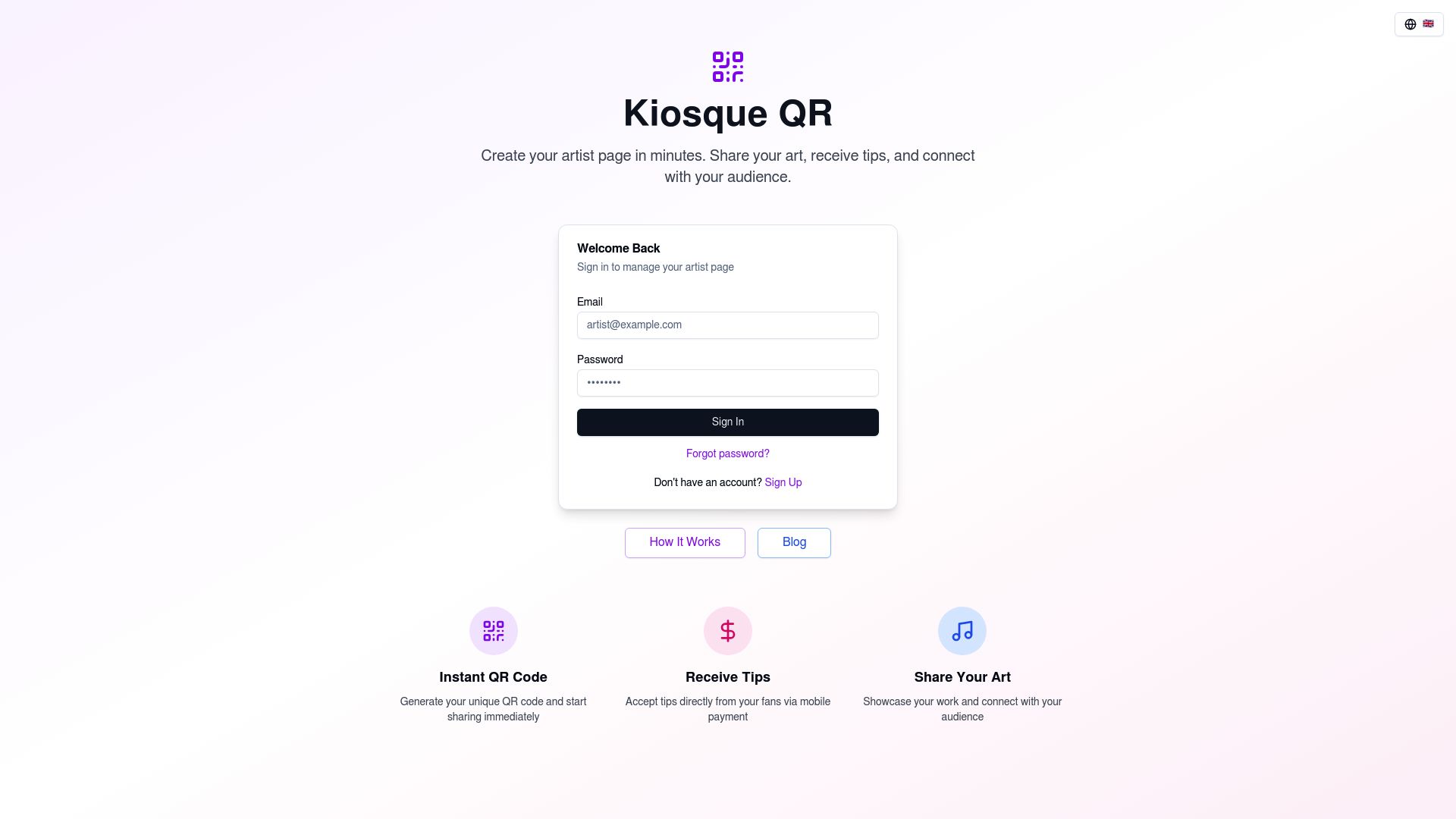
Kiosque QR bridges the gap between the physical world and your digital wallet. It allows you to generate a unique QR code that acts as a digital business card and a payment terminal all in one. There is no app for the fan to download.
They just scan, and they land on your personalized page.
Why it works nicely for artists:
- Zero Technical Skills: You can build your page in about one minute. No coding, no drag-and-drop confusion.
- Instant Gratification: Fans scan the code and can send a tip via PayPal immediately. The friction is almost non-existent.
- Centralized Hub: It creates a "link in bio" experience that works offline. You can link your Instagram, TikTok, Soundcloud, and YouTube all in one place.
If you want to turn a live audience into paying supporters, this is your first stop. It is simpler than a website and faster than explaining your handle to someone in a noisy room.
2. Ko-fi Low Friction Tipping and Shop
If Kiosque QR is your bridge to the physical world, Ko-fi is a fantastic bridge for the online world.
It’s earned a great reputation as one of the friendliest Patreon alternatives for artists, mainly because its whole vibe is so low-pressure.
Ko-fi frames every bit of support as "buying a coffee," which makes it a small, one-time transaction that feels totally casual and easy. There's no pressure or expectation of some long-term commitment between you and the fan. From what we've seen, for visual artists, illustrators, and small performers, this super-easy method often brings in more support overall.
Digging into some recent comparisons, Ko-fi's free plan lets fans send one-time donations without the platform taking a cut.
That means you keep 100% of the money, minus the standard payment processing fees (source).
Key features for creators:
- The Shop: Here, you can sell digital or physical goodies right next to your donation button.
- Commissions: They've even got a built-in feature for people to request custom art or songs.
- No Account Needed: Your fans don't actually need to create an account to send a tip, which is a huge deal for getting more people to contribute.
Honestly, it's perfect if you just want a simple "Tip Jar" on your website or social media bio without the headache of managing a bunch of tiers.
3. Buy Me a Coffee The Simple Support Button
Much like Ko-fi, Buy Me a Coffee (BMaC) is all about keeping things simple. It pretty much does what it says on the tin.
It's built for creators, musicians, and artists who just need an easy way to accept support without any fuss.
You can embed BMaC buttons on your existing portfolio or blog.
It supports one-off donations and memberships, giving you the best of both worlds.
If you decide later that you do want to offer a subscription, you can enable it, but you are not forced to start there (source).
Why choose this over Patreon?
There is a psychological difference. Asking someone to "become a patron" sounds like a serious philanthropic endeavor. Asking someone to "buy me a pizza" sounds like a friendly gesture between peers.
For new artists building a community, that friendly tone matters.
4. Bandcamp The Haven for Musicians
If you make music and you are not on Bandcamp, you are leaving money on the table.
While Patreon attempts to cater to everyone, Bandcamp is unapologetically for the music industry. It is arguably the most ethical platform for selling recorded music and merchandise.
Historically, Bandcamp pays out an average of 80–85% of each sale directly to the artist or label. That is a stark contrast to the fractions of pennies you earn from streaming services.
Fans have paid over $1.52 billion to artists through the platform, proving that music lovers are willing to pay for quality (source).
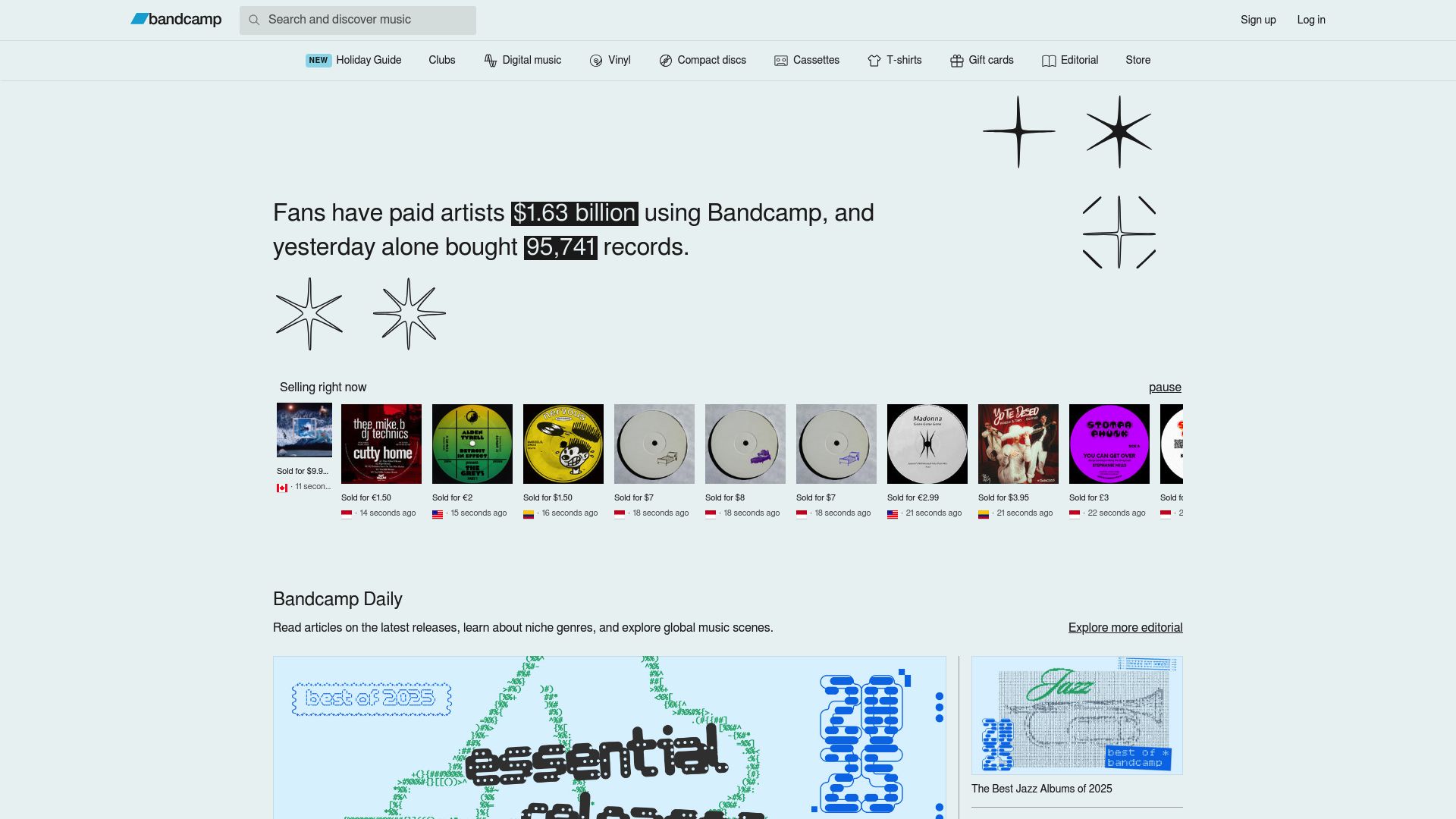
The "Pay More" Culture: One of the coolest things about Bandcamp is its "pay-what-you-want" pricing model. You could set an album price at $10, for example, but the platform actually encourages fans to chip in more if they feel like it.
Honestly, you'd be surprised how often a fan will throw in $20 or $50 for an album simply because they want to support you in a bigger way.
5. Gumroad Direct Sales for Digital Creators
For the digital painters, the sample-pack makers, and the tutorial creators, Gumroad is a powerhouse.
It is one of the strongest alternatives to Patreon for artists who prefer selling products over selling themselves.
Gumroad acts as a simple e-commerce checkout layer that sits on top of your social media. You post a link to a new brush set, your followers click it, and they buy it. Done.
Gumroad charges a flat 10% fee on all creators, which is straightforward and predictable (source).
Why it is attractive: You avoid the "content treadmill." On Patreon, you owe your subscribers something new every month. On Gumroad, you only sell when you have something ready to sell.
You can go quiet for three months to work on a masterpiece, release it as a specialized PDF or video course, and monetize that burst of effort instantly.
6. Sellfy Your Own Branded Storefront
While Gumroad is great for single products, Sellfy creates a feeling of a complete store. If you are an artist who wants to separate your brand from a platform's branding, this is a solid choice. It allows you to sell digital products, subscriptions, and even print-on-demand merchandise all from one dashboard.
When you are looking for alternatives to Patreon for artists, you often worry about "platform risk." What if Patreon bans you?
What if the algorithm changes?
With Sellfy, you are building an email list and a customer base that belongs to you, not the platform (source).
It is particularly good for visual artists who want to sell high-resolution prints or vector assets.
It handles the hosting and delivery of files, so you do not have to email zip files manually at 2 AM.
7. Payhip Protecting Your Digital Art
Payhip is a sleeper hit in the creative community. It operates similarly to Gumroad but has some distinct features for artists who are paranoid about piracy (and let's be honest, we all should be).
Payhip has robust tools for PDF stamping and software licensing.
It is an artist support platform with no fees on their monthly plan if you choose to upgrade, but even their free tier is very usable with a transaction fee. They handle EU VAT automatically, which is a nightmare for any artist trying to sell globally on their own.
If you're selling things like art tutorials, e-books on creativity, or knitting patterns, Payhip also has a membership feature that lets you drip out this content over time.
It's a neat way to build your own version of the Patreon model, but where you're fully in control.
Kseniya Lapteva / Unsplash
8. Podia For the Teaching Artist
Many artists eventually find themselves teaching. You realize that your fans love your work, but they also want to know *how* you did it. Patreon is okay for this, but the interface is not designed for learning.
It is a feed, like Facebook. Old lessons get buried.
Podia is built for courses. It organizes your video loops, PDFs, and assignments into a structured curriculum. It is an all-in-one platform for courses, digital downloads, and communities (source).
The Community Aspect: Podia recently introduced free community plans. You can move your entire fan discussion board off of Facebook and onto your Podia site. This keeps the conversation focused on the art, not distracted by political ads or cat videos.
9. Mighty Networks The Community Hub
Sometimes, the value you provide isn't just your art; it is the connection between your fans. Mighty Networks is an interesting shift away from the "creator-to-fan" model toward a "fan-to-fan" model facilitated by you.
It is often listed as a top choice when your priority is an easy artist networking platform. You can run livestream events, charge for access to specific groups (like a "Songwriters Circle" or "Critique Group"), and host everything under your own brand.
Unlike Patreon, where the interaction is usually limited to comments on a post, Mighty Networks feels like a private social network.
If your art involves collaboration or bringing people together, this is superior to a simple donation platform.
10. "Native" Monetization (YouTube & Twitch)
We cannot ignore the giants. Sometimes the best alternative to Patreon is simply using the tools built into the platforms where you already live.
YouTube and Twitch have realized that they were losing money to Patreon, so they built their own versions.
YouTube Channel Memberships: If you already have a following on YouTube, Channel Memberships allow fans to "Join" your channel for a monthly fee. They get badges and emojis. The cut YouTube takes is higher than Patreon (30% vs 5-12%), but the conversion rate is often higher because the "Join" button is right next to the video.
Twitch Bits and Subs: For live performers, Twitch is a beast.
The culture of "gifted subs" and "bits" (virtual tipping) is ingrained in the platform. Viewers are trained to tip. It is gamified.
If you can handle the pressure of being live, the revenue potential here is massive.
Choosing the Right Stack for Your Art
You do not have to pick just one.
In fact, the most successful artists use a "stack" of tools to cover different bases. Relying on a single platform is risky.
If that site goes down, your income goes to zero.
Here is a practical way to combine these alternatives to Patreon for artists for maximum effect:
The "Live Performer" Stack
If you play gigs, do street theater, or sell art at markets, you need speed.
Primary Tool: Kiosque QR (For in-person, instant tipping via QR code).
Secondary Tool: Bandcamp (For selling your albums or merch after the show).
Social: Instagram (To announce where you will be next).
The "Digital Educator" Stack
If you create tutorials or sell assets.
Primary Tool: Podia or Payhip (To host your courses and files).
Secondary Tool: YouTube (To draw traffic and provide free value).
Tip Jar: Buy Me a Coffee (Perfect for fans who just want to say thanks without buying a full course).
The "Visual Artist" Stack
Let's say you paint, draw, or sculpt.
Primary Tool: Sellfy (To handle your print and original sales).
Secondary Tool: Ko-fi (To manage commissions and small one-off donations).
Community: Mighty Networks (To host something like a paid "sketch-along" club).

The Business of Art: Taxes and Mindset
Whichever platform you ultimately choose, just remember that stepping away from Patreon also changes how you need to manage the business side of your art.
You need to be organized.
Keep track of your earnings.
This freedom comes with responsibility. But looking at the fees, it is often worth it.
Patreon takes a cut, then the payment processor takes a cut, and then currency conversion takes a cut. Using a direct link or a low-fee shop can save you 5% to 10% of your gross income. Over a year, that is enough to buy a new guitar or a high-end tablet.
Final Thoughts: Take Back Control
The era of the "starving artist" is ending, but so is the era of the "platform-dependent artist." You do not need to beg an algorithm to show your posts to your own followers.
You do not need to lock your best work behind a paywall if that does not feel right to you.
By exploring these alternatives to Patreon for artists, you are building a more resilient career. You are diversifying your income streams.
You are meeting your fans where they are.
If you are ready to start with something simple, effective, and designed for the real world, look at how you are collecting support right now. Are you making it easy?
Or are you making your fans jump through hoops?
Take the first step today. Simplify the process.
Create your Kiosque QR artist page now. It’s free to get going, takes only minutes to set up, and means that the next time someone falls in love with your work, they can show their support instantly.
FAQ: Alternatives to Patreon for Artists
1. Which platform has the lowest fees for artists?
Ko-fi is known for being one of the cheapest options out there because they take a 0% cut of donations (you just pay the normal PayPal/Stripe processing fees). Kiosque QR also offers a streamlined way to get paid directly via PayPal without middleman platform fees taking a chunk of your tips.
2. Can I use these platforms if I don't have a large following?
Absolutely.
In fact, platforms like Kiosque QR, Buy Me a Coffee, and Ko-fi are better for small followings than Patreon. Patreon relies on a conversion rate of 1-5% of your audience.
If you only have 100 followers, that is 1 to 5 patrons. Tools for direct tipping let you earn money from those casual encounters without needing to have a massive crowd of followers.
3. Is it better to sell products or memberships?
It really depends on how you work. If you're creating new art consistently every single week (like a comic strip or a podcast), memberships can be fantastic.
But if you tend to work in bursts—like dropping an album or a new brush pack every 6 months—then selling individual products on Gumroad or Bandcamp will probably feel more sustainable and way less stressful.
4. Can I use Kiosque QR alongside Patreon?
Yes, absolutely!
Many artists do exactly this. They use Kiosque QR for their real-world presence (think shows, galleries, or on the street) to catch that immediate wave of interest.
At the same time, they'll put a Patreon link on their Kiosque QR page for those superfans who are ready to offer more long-term support.